For parents of driven, capable teens

Simple systems, purposeful pathways to success

Graphic chart with three bars in light blue, black, and orange, with a hand holding a pencil drawing an arrow on the bars.

A free guide for parents of bright, capable teens who keep falling short of their potential.


If your teen is smart, driven, even excelling in sports or activities — but constantly missing deadlines, melting down over homework, or leaving everything to the last minute — it is easy to assume they just need to try harder.

Often, that is not it. The real issue is usually a gap in executive function: the mental skills that let us plan, prioritize, start tasks, and manage time. It is especially common in high-performing student-athletes juggling academics, practice, and everything in between.
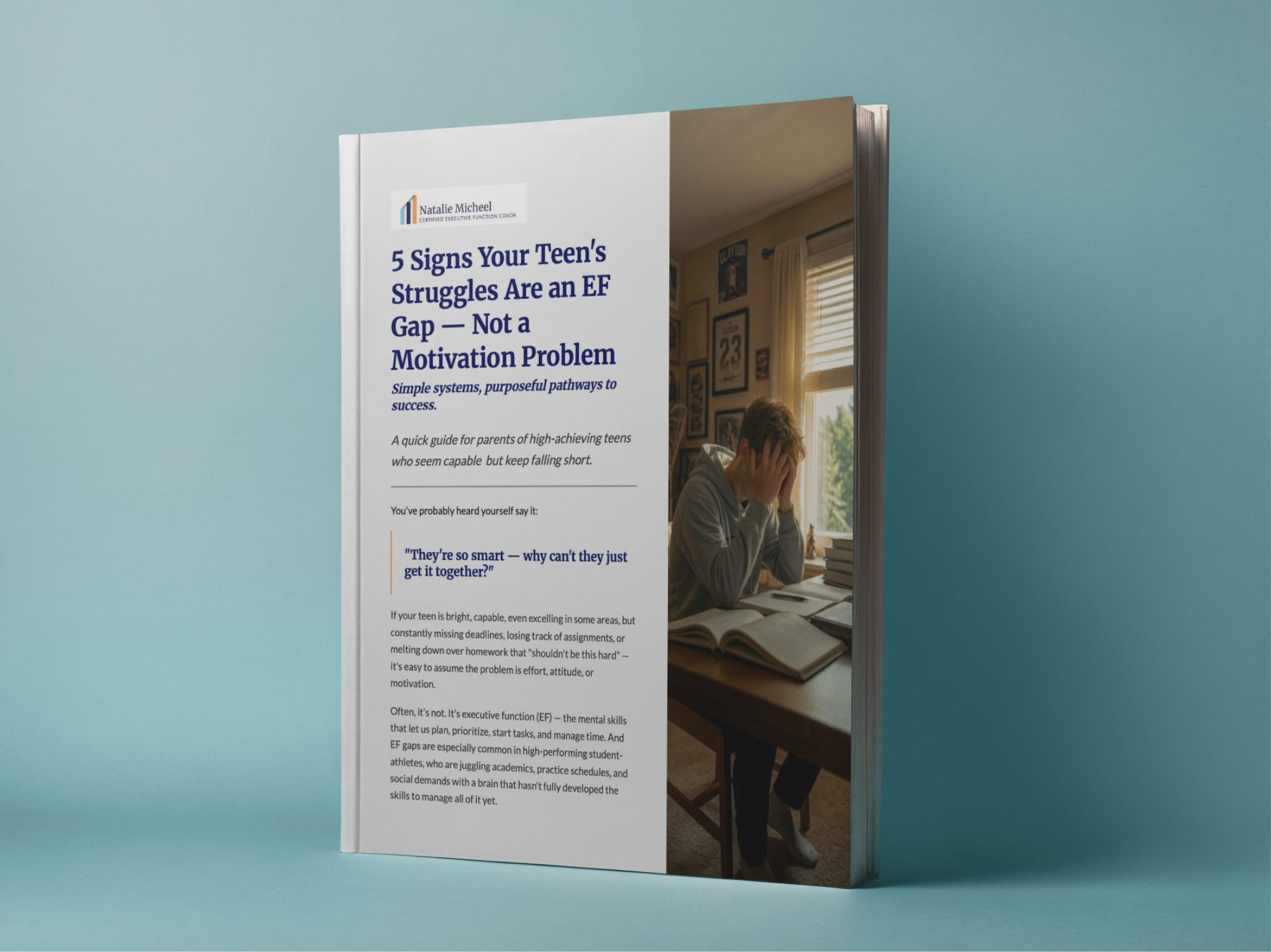
A magazine or brochure page featuring an article titled '5 Signs Your Teen's Struggles Are an EF Gap – Not a Motivation Problem'. The page includes a photo of a young person sitting at a desk with their head in their hands, surrounded by books, in a room with framed pictures on the wall and a window with blinds, while the main text discusses executive function and adolescent struggles.

FREE GUIDE

5 Signs Your Teen’s Struggles Are an EF Gap - Not a Motivation Problem

What’s inside:

The 5 clearest signs your teen is dealing with an EF gap, not an attitude problem

Why “just try harder” does not work — and what does

A simple gut-check to see how many signs apply to your teen


Written by Natalie Micheel, Certified Executive Function Coach and founder of BestEFC.

A bar graph with three vertical bars of different heights and colors: blue, black, and orange. The bars are positioned from shortest to tallest from left to right. There are no labels or axes visible.